
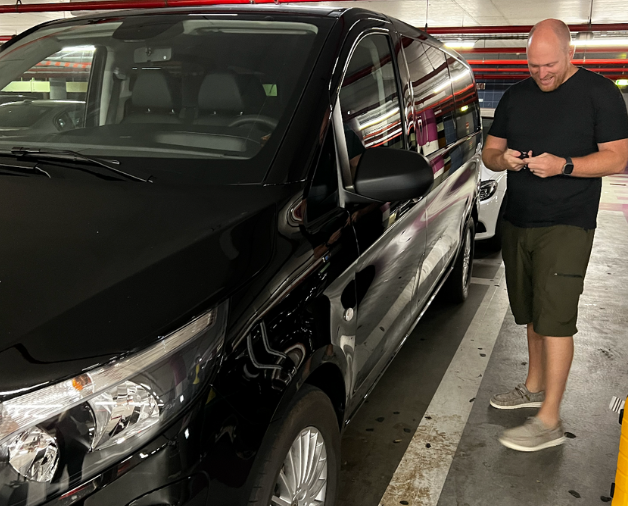
Driving in Portugal is a great way to explore the country, from the bustling streets of Lisbon to the scenic coastline of the Algarve. Like most of Europe, you don’t really need a car in the cities. The larger the city, the more pain having a car is. Parking can be a nightmare and tickets are fairly common for parking mistakes. In fact, we’ve had our car towed in Lisbon! It was in the way of the tram (just by an inch with the mirror) and so they towed it out of the city in about the hour we were inside a building. Yikes. That wasn’t fun.
While it’s not particularly difficult, international driving does require some preparation. We arrived in 2021 after having driven in Europe for six months while traveling full-time. We did a long-term car rental and enjoyed road trips around Europe during that time. We felt confident that we could navigate the road.
However, it even took us a bit to get used to the roundabouts. Portugal uses them all the time. In fact, in our everyday life, it is extremely rare to have a traffic light! It is all roundabouts. The only exception to this is the marginal, road running along the ocean. This has lights to control the speed of traffic and allow for crosswalks.
There are a few things that might surprise you, from roundabouts to road signs and toll systems. If you’re planning to drive in Portugal, here’s what you need to know to navigate the roads smoothly.
*Disclaimer: This post may contain affiliate links. Opinions shared are my own, and I only endorse products I support. By clicking on any of the links below, I may get a small commission if you purchase at absolutely no additional charge to you. I appreciate your support.*
Chapters
- 1 Roundabouts Rule the Roads In Portugal
- 2 Scooters & Motorbikes Between Cars In Portugal
- 3 Understanding Road Signs In Portugal
- 4 Parking Challenges in Portugal
- 5 Pedestrians Have the Right of Way In Portugal: For Real
- 6 Cobblestone Roads and Driving Comfort in Portugal
- 7 Marginal Roads and Coastal Drives in Portugal
- 8 Speed Limits and Honking Culture
- 9 Gas Stations and Fuel Types in Portugal
- 10 Traffic Violations, Radar, and Handling Tickets in Portugal
- 11 How to Handle a Traffic Ticket in Portugal
- 12 Driving in Portugal: An Unexpected Story
- 13 Additional Reading
Roundabouts Rule the Roads In Portugal
Portugal loves its roundabouts, and once you get used to them, traffic flow will be much smoother than that of traditional traffic lights. However, understanding the rules is key to avoiding confusion and accidents. I got many honks in the beginning when I wasn’t doing it right!
- The car already in the roundabout has the right of way.
- If there are multiple lanes, the inside lane is for continuing around, and the outside lane is for exiting. This was something I did completely wrong. I was in the outside lane, thinking “I’m getting off soon!” Now that I look back, isn’t everyone about to get off?! That is the concept of a roundabout.
However, you cannot go more than one exit in the outside lane, and even that is kind of frowned on. You are expected to get to the inside lane until right before you exit. This can be complicated, but if everyone is generally following this, it is very smooth.
- Only go to the right in a roundabout!! My father-in-law, not familiar at all with roundabouts, actually went left and was met face-to-face with a bus!
- Always use your turn signal when exiting to alert other drivers. Turn signals are KEY. They help everyone. Im only lazy about this when I’m basically going straight but it’s a singal lane roundabout and you are in it for just a second.
If you’re unfamiliar with roundabout etiquette, reviewing the official rules before getting behind the wheel is worth some time.
Scooters & Motorbikes Between Cars In Portugal
One significant difference you’ll notice when driving in Portugal versus driving in the US is that scooters and motorbikes often weave between cars, especially in city traffic. We’ve seen this in other countries too (especially Asia), but they can be aggressive in Portugal.
Scooters and motorcycles expect you to have your car slightly off-center in the lanes to allow them to pass and they will honk at you (especially if traffic is stopped or very slow). You need to be constantly looking in your mirrors and be aware of them. I’ve seen them knock on mirrors and drive away!
As dangerous as this all seems, I’ve only seen one actual accident with a car and scooter in our nearly four years of living in Portugal. It seems to work, somehow.
Be extra cautious when changing lanes or making turns, as scooters and motorbikes can appear suddenly in your blind spot. Give them space and be prepared for their unpredictable movements.
Understanding Road Signs In Portugal

While many road signs follow international symbols, there are a few differences to be aware of:
- “STOP” signs are rare – instead, you’ll often see yield signs. However, when you do see stop signs, they say STOP in English. This is different than other European countries that change the language on the sign.
- Speed limit signs are in kilometers per hour (km/h). The conversion of this is not exact, but roughly double. Freeways tend to be up to 120 km/hr (about 75 mph). City driving away from residential is around 50-70 km/h (30-45 mph roughly), and residential is around 30 km/hr (roughly 20 mph). The problem with Europe is that cities are basically ALL residential. 30 kpm is a standard speed for our everyday.
- Brown signs indicate tourist attractions.
- Blue signs usually mark highways.
Common Road Signs in Portugal
Below is a collection of common road signs in Portugal with their meanings:
- STOP (Parar) – Requires a full stop before proceeding.

- Yield (Cedência de Passagem) – Drivers must give way to other vehicles.

- Speed Limit (Limite de Velocidade) – Shows the maximum speed allowed on the road.

- Pedestrian Crossing (Passagem para Peões) – Indicates a crosswalk where vehicles must stop for pedestrians.

- No Parking (Estacionamento Proibido) – Parking is not allowed in the marked area.

- Roundabout (Rotunda) – Alerts drivers to upcoming roundabouts.

- Highway Entrance (Autoestrada) – Marks the entrance to a highway.

- No Entry (Entrada Proibida) – Prohibits vehicles from entering a certain road.

- One-Way Street (Sentido Único) – Indicates that traffic only flows in one direction.

Parking Challenges in Portugal

Parking can be a challenge in cities like Lisbon and Porto or in the Algarve. In fact, I just expect parking is always going to be a challenge and I’m rarely pleasantly surprised. Visiting anyone in their home often is difficult in the cities. Grocery stores have parking, but you might have to enter a restricted or paid area. It’s never really easy to park in Portugal unless you are outside the cities.
Here’s what to know about parking in cities in Portugal:
- Paid parking is typical in urban areas, with machines for tickets. In fact, always assume you need to pay for parking and you’ll nearly always be correct. I didn’t realize this for a long time and thought some sidewalks were OK to park on for free.. Nope. We’ve gotten our fair share of parking tickets.
- When you exit your car, look around for a parking sign with a color. This will tell you what the fee is, but you still need to find a machine and have coins. Most machines require coins (usually about 1€ per hour) and you’ll need to put the paper ticket in your car on the dash.
- Some machines allow you to use MB Way, but these are rare.
- The BEST option for parking? Use the “Estacionar” app. This is tied to our Via Verde account (more on that to come and, really, this only applies to expats). It is so easy to use. Just park, open the app and select the amount of time you want to pay for.
- Note: Once you park for your first round of parking, you can only extend once. Most parking zones in Lisbon have a time limit (typically two hours). The only way to get around this is to use the app first, then physically go to your car, get a ticket from a machine, and put it in your car.
- Note: Once you park for your first round of parking, you can only extend once. Most parking zones in Lisbon have a time limit (typically two hours). The only way to get around this is to use the app first, then physically go to your car, get a ticket from a machine, and put it in your car.
- Some areas require you to display a blue parking disc (available at local shops or gas stations). I’ve not run into this situation, personally.
- Illegally parked cars can be towed or fined or booted (a contraption on your tire so you cannot drive), so always check for signs. You may think you are parked legally and you are not.
- Many older neighborhoods have narrow streets with limited parking; consider using public transport instead. Thankfully, Uber or rideshare is relatively inexpensive in Portugal.
Pedestrians Have the Right of Way In Portugal: For Real

Portuguese law strongly protects pedestrians. You’re required to stop at crosswalks if someone is waiting to cross. Unlike in some countries where pedestrians hesitate, in Portugal, they expect cars to stop, and they will step into the road with confidence.
In reality, most pedestrians are not even looking. Children cross often as well, which is great for my children, but a bit scary as a driver. You have to be paying very close attention when driving in Portugal. Absolutely do not get on your phone while driving.
Many don’t even own a car in Lisbon and the public transport game is really strong. This is one of my favorite parts of living in Lisbon, but driving is not taken lightly.
Cobblestone Roads and Driving Comfort in Portugal


Many older streets in Portugal, especially in historic city centers, are made of cobblestone. While charming, they can be slippery in the rain and rough on your suspension. Drive carefully, and be prepared for a bumpy ride in some areas.
Also, be prepared to always stop! Driving in Lisbon can be a test of your nerves.
Marginal Roads and Coastal Drives in Portugal

If you drive along the coast, you may encounter roads referred to as “marginal roads,” which run parallel to the ocean. These scenic routes are beautiful but often congested, especially in summer. Expect slow-moving traffic and plan extra time for your journey.
We pinch ourselves every time we drive on the marginal near our home. It’s stunning and unreal that we can live so close to the ocean!
Speed Limits and Honking Culture
Speed limits vary by location:
- 50 km/h (31 mph) in cities
- 90 km/h (56 mph) on rural roads
- 120 km/h (75 mph) on highways
In my opinion, Portuguese drivers don’t honk excessively, but this is very much just my opinion. We’ve been around the world and in India or Thailand or Bali, the honking is literally non-stop. However, many Americans think the honking is excessive in Portugal.
Honking is usually a sign of frustration or a warning. If you hear honking, it’s likely because someone thinks you’re driving too slowly or hesitated too long at a green light. Or, like me in the beginning, you are using the wrong lane in the roundabout!
Gas Stations and Fuel Types in Portugal
Gas stations in Portugal are widely available along highways and within cities. However, there are some key differences to note:
- Diesel vs. Gasoline (Petrol) – Many cars in Portugal run on diesel, so always double-check before refueling. Diesel is labeled “Gasóleo”, while gasoline is labeled “Gasolina”. This drives us nuts as it is way too similar. And yes, once we put the wrong fuel in our rental car!
- Thankfully, it’s not that uncommon. We had to get the car towed and pay about 200€ to drain the tank and fix it. Ugh!
- Thankfully, it’s not that uncommon. We had to get the car towed and pay about 200€ to drain the tank and fix it. Ugh!
- Self-Service vs. Attended Service – Most stations are self-service, but some still offer attendants who can fill your tank for you. We don’t have any attended stations near us, but perhaps outside the cities.
The best course is the drive up and wait about 30 seconds to see if anyone comes. If they do, they will want to know:
- Gasoline or diesel?
- How much?
- You can hand over your card for payment or they might bring the machine to the car.
- Payment Options – Credit and debit cards are widely accepted, but some stations, especially in rural areas, may only take cash. It’s a good idea to always have some Euros, especially coins, handy.
- Toll Road Gas Stations – Fuel on highways tends to be more expensive than in towns. If possible, refuel before a long highway drive.
- 24/7 Availability – While most urban gas stations operate 24/7, rural stations may close overnight. However, most gas stations are NOT self-pay. You either neither to pay before you fill or after, but it’s rare to have self-pay at the machine.
Traffic Violations, Radar, and Handling Tickets in Portugal

Portugal has an extensive network of speed cameras and radar traps, especially on highways and urban roads. Speeding tickets and other traffic fines are common, so it’s important to be aware of the rules and how to handle fines if you receive one.
Speed Cameras & Radar Traps
- Many highways and urban areas have fixed speed cameras that automatically issue fines. You’ll find out by mail later!
- The map app Waze alerts you to these areas if you are worried.
- The map app Waze alerts you to these areas if you are worried.
- Mobile radar traps are frequently set up by police on both highways and smaller roads.
- Speed cameras often have warning signs ahead, but not always—so it’s best to stick to the speed limits.
- I find most people in Portugal to follow the speed limit. You’ve always got the speed demons, but most are driving at or below the speed limit.
Common Traffic Violations & Fines
- Speeding – Fines range from €60 to over €2,500, depending on how much over the limit you were going. We’ve gotten several tickets over our years in Portugal (mostly from the marginal near our house) and most are around 100-120€.
- Running a red light – Fines start at around €120.
- Parking violations – Expect a fine between €30 and €150.
- Using a phone while driving – Fines range from €250 to €1,250.
- Not wearing a seatbelt – Expect a fine of at least €120. This gets a little fuzzy in taxis and Ubers, like most of the world.
How to Handle a Traffic Ticket in Portugal
- Receiving a Fine – If you are pulled over, the police may issue a fine on the spot. You can either pay immediately (sometimes at a discount) or request a formal notification.
- We had to pay a fine on the spot for our car registration.
- We had to pay a fine on the spot for our car registration.
- Paying the Fine – You can pay at an ATM, online, or at a post office, depending on the issuing authority.
- ATM payments in Portugal are super cool. A lot of bills you get (utilities, taxes, etc) can be paid through an ATM. You’ll have a reference and entity number. On the ATM, you select payments and then enter in the reference and entity and amount. Click accept and, voila! Bill paid from your checking account.
- ATM payments in Portugal are super cool. A lot of bills you get (utilities, taxes, etc) can be paid through an ATM. You’ll have a reference and entity number. On the ATM, you select payments and then enter in the reference and entity and amount. Click accept and, voila! Bill paid from your checking account.
- Contesting a Fine – If you believe the fine was issued unfairly, you can contest it through IMT or the local police department by submitting a written appeal.
- I’m probably too chicken to take this personally, but I’d recommend enlisting a Portuguese speaker’s help.
- I’m probably too chicken to take this personally, but I’d recommend enlisting a Portuguese speaker’s help.
- Rental Cars & Tickets – If you receive a fine while driving a rental car, the rental company will be notified, and they may charge you an additional fee for processing the fine. You’ll probably receive this in the mail weeks or even months later. We’ve gotten tickets from Portugal more than 12 months after the violation. We’ve also gotten tickets by mail from Switzerland, Spain, and Italy. Can you tell someone in our family has a need for speed? 🙂
- Unpaid Fines – If you don’t pay a fine, it could lead to additional penalties, including being blocked from renewing your license or vehicle registration. Tourists are not held as accountable for unpaid fines, but expats need to stay on top of paying these.
Overall, driving in Portugal can be manageable and enjoyable. With some preparation and cautious, defensive driving, you can enjoy cruising down the marginal as you dreamed of.
Driving in Portugal: An Unexpected Story


Got questions? Leave them below!


Additional Reading
Why Your Family Will Love Camping in Portugal
Serra da Estrela: Portugal’s Only Ski Resort and Stunning Mountains
Eating Your Way Through Portugal – Traditional Food You Can’t Miss!
Leave a Reply